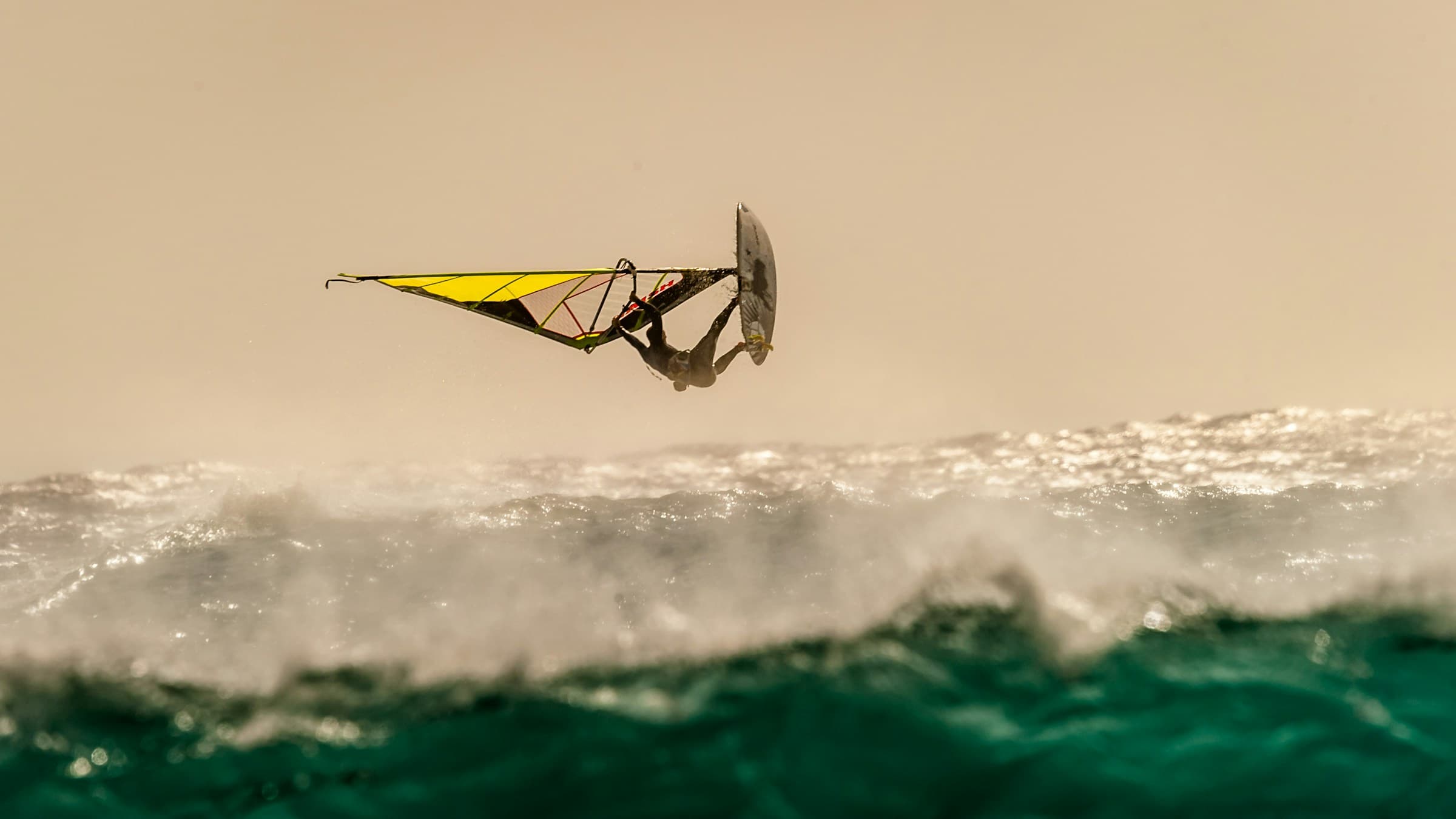
Windsurfing is a water sport that combines elements of both sailing and surfing. It emerged in the late 1960s and became an Olympic sport in 1984. With the appearance of other extreme sports, windsurfing experienced a brief dip in popularity, but it has been on a steady rise again since the 2000s.
Modern windsurfing boards can be classified into many categories. The original windsurfing board had a body made of polyethylene filled with PVC foam. Later, hollow designs made of glass-reinforced epoxy were introduced.

The equipment required for windsurfing includes:
- Mast
- Boom
- Fin (similar in shape to a surfboard fin, but usually stronger for windsurfing)
- Universal joint (elastic joints are more common, but some are mechanical)
- Harnesses and lines
- Wetsuit
- Footwear
- Helmet
- Personal flotation device
Riding Technique: A windsurfing board is powered and controlled by the coordinated movements of the sail around its single joint and the sailor around the board. This is achieved by balancing the sailor's weight against the wind pressure in the sail, while both factors are adjusted in relation to the board. Learning this involves developing reflexes and "muscle memory," similar to the process of learning to ride a bicycle.

These skills are usually and optimally practiced on large, buoyant boards in light winds on flat water. Depending on wind conditions and the rider's skill or intentions, the board will eventually begin to plane, resulting in a rapid increase in speed. This higher speed requires learning new skills as the apparent wind changes and the board becomes maneuverable, much like a surfboard.